Showing posts with label ARC. Show all posts

Wednesday, February 24, 2016

REVIEW | Fantasy | Steal the Sky by Megan O'Keefe

Steal the Sky by Megan O'Keefe
Publication Year: 2016
Genre: Science Fiction
Series: The Scorched Continent #1
Awards: NA
Format: Advanced Reader Copy from Angry Robot.  Receiving the book for free does not impact my review.
Narrator: NA

WHY?:  Flying Sailing Ships!  The blurb gave me Firefly feels.

SYNOPSIS: Aransa is a mining city in an environmentally hostile area known as the Scorched. At one point it was apparently a tropical paradise but war or some similar event in the past has wiped out all vegetation. What the area is rich in is Selium. Sel is a gaseous substance that creates energy and supports flight and it can be manipulated by people known as Sel-sensitives. Because of their abilities, Sel sensitives have become almost a slave caste - they are forced to work in the mines or in other dangerous and subservient positions. And at least one of them isn't gonna take it anymore. Unfortunately for petty conman Detan, he gets sucked right into the middle of a couple of clashing plots along with his sidekick Tibs and the City Watch Captain Ripka.

It is almost certainly a mistake to go into a book with expectations that it will be like this-thing-that-I-love-so-hard.  It is a thrill when it actually is like the thing but more often than not, it is its own beast and that's okay.  Okay but disappointing.  Steal the Sky was not Firefly in book form.  There isn't even a single character that really evoked the Firefly cast though if you squinted real hard Detan and his not-really-sidekick Tibs bare a passing resemblance to Mal and Zoe.  But then they call people chums and women lasses and I was wondering if I'd strayed into the middle of Bertie Wooster's holiday in Scotland.  The point is, I had unfair expectations.  Don't make my mistake or you might find yourself disappointed.

Because I was slightly disappointed in Steal The Sky.  Partly because of my confession above - totally my fault - but partially because the book had a LOT of promise which wasn't fulfilled. The story and characters just never quite gelled for me.  

But let me back up and talk about what did work.  The world building and the magic system was very, very cool.  The city of Aransa worked as a colorful and rough-and-tumble backdrop for the story. An island of survival in the middle of a deadly desert. It was conquered or established (or something) by Valathea but it is no longer under that country's or far off city's rule.  Maybe.  I found the political plot line very confusing and at least for me it could have used a lot more fleshing out.

It was fine though because the heart of the story is really the sel sensitives and their plight. They have this special and very cool ability but instead of it giving them power in society, they are basically enslaved. They do perhaps have more financial stability than the other poor people but they risk their lives every day and are not at all compensated the way they should be.  No one really wants to admit they are sel sensitive, especially if their abilities are strong and they can manipulate Sel in more complicated ways than just moving it.  Those talents mean they are dangerous and it does make them powerful. So this is kind of a rebellion story.  It starts with a lone woman, Pelkaia, a very strong sel manipulator who has a gripe with the powers that be.  By the end of the book, her personal vendetta has gotten mixed up with a larger political play and she may have, in fact, started a revolution.

Pelkaia is an enigmatic figure throughout the book, partially because we so rarely see her being herself - she is usually masquerading as others behind a sel mask.  I liked that she was a character whose motives may be understandable and sympathetic but who takes things a little too far into the dark side.  The other main characters are as mentioned, Detan who is a con man, petty crook and all around okay guy.  Ripka is the Watch Captain of Aransa with a reputation for being tough but fair and very well respected.  She and Detan have crossed paths before.  Beyond these three perspective characters, the cast is rounded out by Tibs, Detan's laconic sidekick and the big bad antagonist Thratia who seems to have some shady political goals and is throwing her weight around in Aransa using her fearsome reputation.

I liked the characters okay but really wanted more from them.  I was very intrigued by Ripka but the narrative ended up spending very little time with her and she is never really fleshed out.  Detan was inoffensive but I never really got a sense of who he was despite the fact that most of the narrative sticks with him.  Basically, all the characters have aspects that feel real but they never felt real as a whole.  This unfortunately bleeds into their relationships.  Detan gets all worked up when Ripka gets in trouble and risks his life to save her but they don't really interact all that much in the book and the book in no other way makes it clear that they are any more then acquaintances so it feels odd.  I could've gotten behind a few hints of romance around the two - I love a good bad-ass female rule follower-free wheeling con artist pair up but the author doesn't really go there. I think?  Detan seems to have strangely sentimental feelings about many of the female characters so it's hard to know.  

Beyond the characters not totally working, I also thought the pacing was a tad slow and the tone a little too serious.  I wanted wisecracking wit and mad-cap escapades and it feels like the book was set up to have those things but it just didn't.  It's not grim-dark or anything but it doesn't get close to the light and airy concoction that could have made this akin to a heist book.

The bottom line is that this really felt like a debut novel. One with promise but needing a good bit more polish and practice.  It is not bad by any means and was a solid three star read for me.  It may have snuck up to 3.5 if I hadn't had those Firefly expectations.  I'll be interested in what Megan O'Keefe writes in the future.

FINAL VERDICT:  This book was an enjoyable fantasy novel with a lot of promise that just didn't quite deliver on that potential.  I will keep a look out for Megan O'Keefe's future books but not obsessively so.  3 out of 5 stars.


Other Opinions Do Exist:  Beauty in Ruins |  Lynn's Book Blog |

Tuesday, September 29, 2015

REVIEW | Unfinished Business: Women, Men, Work, Family by Anne-Marie Slaughter

https://www.goodreads.com/book/show/25614228-unfinished-business
Unfinished Business: Women, Men, Work, Family by Anne-Marie Slaughter
Publication Year: 2015 (September 29th)
Genre: Non-fiction, Work Culture
Series: NA
Awards: None
Format: Advanced Reader Copy from Penguin Random House.  Receiving the book for free does not impact my review.
Narrator: NA

WHY?: Work-Life balance and modern feminism are both topics that interest me.

At first glance, I am an unlikely reader of this book.  I am unmarried and have no children.   However, even with fewer obligations in my personal life, I still struggle with the desire to live a fulfilling, well-rounded life that does not wholly revolve around my job.  If you are a working person with a family at home, Unfinished Business will be a very interesting and perhaps even important read for you but even if you do not have care obligations but are flummoxed by America's very intense work culture you will find the ideas presented in this book worthwhile.
"I began to wonder why success as a woman, or indeed as a man, meant privileging career achievement above all else."
Anne-Marie Slaughter is an ambitious and successful career woman.  Trained as a lawyer and having an expertise in foreign policy, she has taught at Ivy League universities and served as Dean of the Woodrow Wilson School of Public and International Affairs at Princeton University before leaving to become the first woman Director of Policy Planning under Hillary Clinton as Secretary of State.  Her position on Clinton's staff required her to move away from her husband and two sons only commuting back on weekends.  After serving for two years, Slaughter decided that she needed to be back in Princeton for her family and while she got a very nice send off, the overall sentiment was that she had somehow failed by "giving up" this prestigious position for reasons of family.  In response, she wrote an article for The Atlantic entitled "Why Women Still Can't Have it All" which created an enormous response.  The questions and challenges she received in response to this article is what prompted this book, which is a more detailed exploration of the current state of feminism and the issues with America's work culture.
"Advice on how to achieve a sane work-life balance has become a cottage industry. Numerous books on the subject have been published...But they are all aimed at workers, overwhelmingly women, who are presumed to have the responsibility of stretching the twenty-four hours in a day to cover and impossible and never-ending list of things to get done.  Why not tackle this issue from another angle? Perhaps the problem is not with women but with work."
Slaughter approaches the issue in a very organized fashion.  She clearly states and explores the problem, with statistics, research and anecdote, and then methodically lays out the causes and proposes possible solutions.  Her writing style is engaging and easy to get into and never gets too repetitive or if she does repeat herself it is in a sufficiently different way that it serves to elucidate rather than annoy.  She makes very clear that she is writing from her own experience, that of a professional, upper middle class woman, and that is where the bulk of the narrative is spent but she does make a point of recognizing and including others in her solutions.  Many of the responses she received in response to her original article forced her to examine the larger problems that exist.
"In the process of writing this book, responding to reflections, questions, and critiques from many different people from many different backgrounds, I have realized time and again just how much my own experiences inevitably shape my assumptions about how others think and feel.  As I have tried to put myself in others' shoes, I have confronted again and again the obvious but too often overlooked of just how much money matters."
And those larger problems?  One of her biggest points is that they are not just women's problems.  The real issue she defines is a conflict between career and care-giving where care-giving is extremely undervalued.  This goes for women and men and is exemplified by the low pay, training and status of professional care-givers. She points out that while women have made some strides towards equality in the workplace, men still face huge biases and stigma for wanting to play an equal or full time part in care-giving of their children and household.  And that stigma is not just from workplace managers; but from spouses.  She points out that many women assume that they know what's best in running the household and caring for the children and don't trust their husbands to care for the children "the right way".  This whole topic was enough for me to want hand this book out to every married-with-children woman I work with, because every single one of them has this bias at home. I'm not criticizing - I would be the same way - but just as men have to be willing to relinquish control of how work is done, women must relinquish some control in the home for true equality to be a reality.  

"...our assumption that wanting "work-life balance"  - or even just wanting a life outside of work - signals a lack of commitment to that work.  That assumption reflects a mindset that promotes men with full-time wives and no life."
"That is the lens that same-sex couples offer the rest of us.  It is no longer possible to assume, even at the subconscious level, that one member of the couple will be better at raising children and running a household and the other will excel at earning income and climbing a career ladder."
"To counter these assumptions and carefully prescribed roles, men need a movement of their own. Most of the pervasive gender inequalities in our society - for both men and women - cannot be fixed unless men have the same range of choices with respect to mixing care-giving and breadwinning that women do."
Slaughter ends the book by suggesting a number of possible solutions from the personal - having frank discussions with your partner early on about the willingness to sacrifice career for care-giving during points of their career - to the professional - convincing businesses to consider the unique talents of a late forty-something coming back into a profession after dialing down to raise a family.  The point is that there must be a fundamental shift in American work culture from the bottom to the top where care-giving is valued and where the complete subsuming of life to work is not necessary.  The system must change.
"We have re-defined feminism as women's right to be owned by the system, to be owned as much as men have been owned."
"Valuing care also offers a compass to a new set of workplace and national policies.  Challenging employers, politicians, and ordinary citizens to explain why, exactly, it is more important and valuable to compete with one another than to care for one another."
This book works so well because Slaughter is clearly not immune to current society's messaging about success and the proper way to do business - she is fighting her own biases.  She confronts them and is constantly checking herself and trying to expand the ideas out and make them relevant for all without letting the book get too overwhelming.  This is not a book that is all about how women have been wronged, it is about how we are all hurting under the weight of a work culture that is still stuck in the past and a society that values work too much at the expense of the personal.  If you have any interest in any of this, I think you will find it an incredibly satisfying, validating or at the very least interesting read.

FINAL VERDICT:  This is a wonderfully succinct and thoughtful book for anybody interested in feminism, work-life balance or America's work culture.  Five out of Five Stars.


Tuesday, August 18, 2015

REVIEW | Hostage Taker by Stefanie Pintoff

https://www.goodreads.com/book/show/24388317-hostage-takerHostage Taker by Stefanie Pintoff
Publication Year: 2015 (August 18th)
Genre: Thriller, Mystery, Crime
Series: Eve Rossi #1
Awards: NA
Format: Advanced Reader Copy provided through NetGalley by Random House-Bantam Dell Publishing - Thanks to them for providing this free advanced copy!  Receiving the book for free does not effect my opinion or review of it.
Narrator: NA

I requested this ARC because I am a huge fan of Pintoff's historical mystery series featuring Simon Ziele as a police detective in turn of the 20th century New York.   Hostage Taker represents a complete departure from that series as it has a contemporary setting and it leans closer to the thriller end of things then a straight mystery.  The setting is still New York and it centers around a female  FBI agent, Eve Rossi, whose specialty is hostage negotiations.

When we meet Eve she is on a self-imposed extended leave from the FBI because of a spectacular failed hostage negotiation which made her switch jobs and then the additional blow of her mysterious CIA agent stepfather's violent death.  She gets pulled back into her job when an unnamed hostage taker asks for her by name.  She is intrigued despite herself because the kidnapper has chosen the iconic St. Patrick's Cathedral as his target and his actions are atypical for a hostage taker.  For one thing, asking for Eve by name, for another his only demand is to assemble a group of five people who are seemingly completely unrelated.

Once Eve is sucked in she insists on bringing in her crew - a secret unit of the FBI that is made up of ex-convicts which has been disbanded since she's been on leave.  The crew are all pretty well stock characters that are exactly what you might expect. There's Eli, an awkward accountant type who is such a genius with financial systems he couldn't help but do a little embezzling.  Mace is an alpha male basketball hustler, a man of action with street knowledge and cred. Garcia is a troubled career military warrior who knows explosives and guns and infiltrating difficult places.  Finally, Haddox, a charming Irish rogue who is an expert at using technology to spy and rip people off.  He and Eve have "a past" because of course they do.  He's Irish, and charming and roguish after all.  Round out the cast with an FBI administrator who cares more about politics than being a good boss and you've got a big old pile of rather stale characters but more about that later.

The format of the book was fairly unique.  Chapters are short with the intention of moving the action along and alternate between news bulletins, short diatribes by the mastermind of the hostage taking and narratives of Eve and her team as they try to figure out who the hostage taker is so they can resolve the situation.  The hostage taker is by far the most interesting character in the book.  He/She is mysterious but we do get a peek into their heads.  At first it is confusing because it is unclear who it is that is talking to us in the intermittent chapters that slowly reveal the motives and plan of the hostage taking.  The slow roll out of the hostage taker's intimate feelings interspersed with the desperate activity of the people trying to understand and stop the crisis, works well and still allows for many twists and turns along the way.

As you might guess from the above paragraph, I do think that this part of the book, the actual thriller part, is complex and creative and interesting.  I think for most it will be a page turner.  It kept me reading for sure but perhaps not terribly obsessively which was likely not the book's fault.  Contemporary thriller's are not really my cup of tea.  Set a thriller plot on a British sailing vessel in 1830 or make one of the twists an inter-dimensional time shift and I am riveted but your modern day run of the mill, FBI, blah blah blah thriller is just okay for me.  I took a chance on this book because I love the author and it's a testament to her that I did like the book quite a bit but overall it was just okay.  Not bad, just fine.

The thing that could have offset my general ennui with the book and bumped it up from good to excellent is if I had fallen in love, engaged with, been interested by...SOMETHING...with the characters.  There is a hint of a bigger story with Eve that could be developed into something interesting in future books but the problem here I think is that there was just too much to do.  You can tell by the cover art, Pintoff was going for a fast-paced wild ride of a novel and pulling that off while introducing five ensemble characters is nigh on impossible.  In my opinion, the characterization suffered and fell back on cliches and tired tropes.  There was no time for more development which was a shame.  I compare it with another completely unrelated series which is on my mind because I have been reading a lot of it lately; The Dresden Files by Jim Butcher.  The Dresden Files books are super duper fast paced, non stop action and suspense but I feel like I also have a very high level of affection and knowledge of the characters so what's the difference between this series and Hostage Taker?  I realized that in the Dresden Files we are really only in the head of Harry and really only know him well from the get go.  The large cast of characters who I have great affection for have all been developed slowly piece by piece over 15 volumes.  So Hostage Taker was super ambitious to try and develop reader-character rapport with five characters all at once OR perhaps I just need to give the series a little time to flesh them out.  Finally, and this is the last I'll say about it, we are introduced to these characters in the middle of their relationships which is frequently a problem for me.  I generally like to see things developed from the beginning but if Pintoff had taken that road, it would have involved even more time with the characters and the book would have lost its momentum.

FINAL VERDICT:  I guess it all comes down to what you are looking for.  If it's an action packed police procedural thriller?  This is your book!  It's a solid and even inventive example of this type of book. I liked it but would have loved it, if more attention had been given to character and relationship development among the ensemble cast.  3 out of 5 stars.


Monday, May 25, 2015

REVIEW: The Likelihood of Lucy by Jenny Holiday

https://www.goodreads.com/book/show/25481032-the-likelihood-of-lucy
The Likelihood of Lucy by Jenny Holiday
Publication Year: May 26, 2015
Genre: Romance, Historical (Regency Era Britain)
Series: Regency Reformers #2
Awards: NA
Format: Thanks to Entangled Publishing for providing me with an advanced reader copy of this book (via NetGalley).  My review reflects my honest opinion of and experience with the book and was not influenced by receiving the book for free from the publisher. 
Narrator: NA

Time for another trip back in time to hobnob, dally or perhaps even court ruination in the grand houses and ballrooms of Regency Era England.  I admit I'm a bit addicted to the experience and when reading romance, rarely stray very far from this fascinating era of eligible Dukes and rakish Earls.  Because I visit it on such a regular basis, I much appreciate when a creative and unique approach is taken and that is just what Jenny Holiday has done with her Regency Reformers series of which this book is the second.  Holiday's heroines are a rare commodity in the England of the early 19th  century - they are political activists.   I really loved the first book in the series, The Miss Mirren Mission, whose heroine was an activist opposing slavery. 

In The Likelihood of Lucy, Lucy Greenleaf is a devotee of Mary Wollstonecraft.  Wollstonecraft lived in the late 1700s and was an advocate for women's rights.  Lucy worships her and has decided that marriage is a terrible idea because both of Wollstonecraft's husband/lovers ended up betraying Mary or her legacy.  When we meet Lucy she is in the process of losing her position as governess to two girls because her male aristocratic employer does not appreciate the radical things Lucy has been teaching them.  She is forced to flee and ends up having to knock on the door of her childhood friend, Trevor Bailey.

Trevor played a secondary role in The Miss Mirren Mission as the second in command to Britain's spymaster, The Earl of Blackstone.  Unlike his friend the Earl, however, Trevor is a self made man who spent his childhood with Lucy in the poverty stricken Seven Dials area of London.  He was Lucy's protector in those days, helping her to escape her fate and get an education before pulling himself out of the gutter and becoming a successful businessman.  He is in the process of opening London's first "modern", luxury hotel when Lucy shows up at his door. 

The conflict between the two is interesting.  They are instantly attracted to one another once they meet again as adults but Lucy is protective of her independence and self-sufficiency and Trevor has some serious self-worth issues.  He seems not to realize that he's not the same con-artist boy who had to steal to eat and he thinks, rather infuriatingly, that he knows what's best for Lucy without asking her what she might think about it.  Despite his resolve to not saddle Lucy with his miserable self, they have occasional interludes of smooching and ...ahem... other things, that Lucy enjoys immensely but to which he reacts with guilt and self-loathing for touching her and by hiding in his apartment for days on end.

Needless to say its an interesting set up and relationship.  They are both pretty emotionally dysfunctional and immature which lead to some frustration on my part but is likely quite understandable considering their childhood.  I liked Lucy quite a lot.  She's very self-sufficient and independent.  One nice touch to her character is that she likes to take on self-improvement projects to teach herself a new skill - like baking, flower arranging or learning to speak Danish.  She does it as a means to keep her mind lively and stretch herself.  She denies her feelings for Trevor because she thinks marriage will lead to betrayal and the loss of her self.  Understandable concerns for that era in time. 

So what did I think?  I liked it, particularly the character of Lucy and the exploration of women's rights during that period of English history.  The secondary plot, a series of murders that appear to be politically motivated, is less prominent and integral than the plot in The Miss Mirren Mission but it adds some forward momentum and establishes how Trevor and Lucy have changed since childhood.

On the slightly negative side, the relationship was just okay for me.  I enjoy that the two main characters are outside the aristocracy which is unusual for this subgenre and I do think they make a good pair.  I also really like the friends to lovers trope but it did not work completely for me here for a couple of reasons.  Because of Trevor's penchant for hiding from Lucy, it honestly felt like they did not interact very much and I thought the book struggled a bit to create the tension needed between the two.  There were a lot of threads in the book - Trevor and Lucy's tragic childhood, the serial murders that needed investigating, the opening of the hotel and what that means for Trevor, Lucy's former employer being unable to let go of his contempt for her, an alternative suitor for Lucy and women's rights in the Regency Era PLUS Trevor and Lucy falling in love.  It was perhaps a little too much to cram in there and it felt like the romance got pushed a little too far into the background at times.  Not a problem, of course, if this wasn't meant to be a romance novel but because it is, I wanted the focus to be more heavily on the couple falling in love.  It also seems to me that the friends to lovers trope can be tricky to pull off because it must be harder to create the romantic tension and conflict needed between two people who already know each other well.  My personal preference is to want the story to start at the beginning of the friendship, even if it goes back to childhood, which likely would have required a much longer book! The book flashes back to key moments in Trevor and Lucy's childhood but we don't really get to see them become friends, we are just told that they are.

FINAL VERDICT:  Overall, I like the premise of this series and think this is a good continuation.  Lucy is a unique heroine without falling too far outside believability as a Regency era lady and I enjoy the focus on two characters outside of the aristocracy.    3 out of 5 stars.


So what about you?  Do you enjoy a friends to lovers story and where in that story do you like things to begin?  What do you think works best in this scenario?

Wednesday, March 18, 2015

The Mermaid's Child by Jo Baker

https://www.goodreads.com/book/show/2121443.The_Mermaid_s_Child
The Mermaid's Child by Jo Baker
Original Publication Year: 2004
Genre(s): Historical Fiction
Series: NA
Awards: None
Format: eBook - Thanks to Knopf/Doubleday Publishing Group for providing me with an advanced reader copy of this book (via NetGalley).  My review reflects my honest opinion of and experience with the book and was not influenced by receiving the book for free from the publisher. 
Narrated by: NA


Blurb from Publisher:
In this fantastical novel, the acclaimed author of Longbourn brings us the magical story of a young girl in search of her mother...who just might be a mermaid. Malin has always been different, and when her father dies, leaving her alone, her choice is clear: stay, and remain an outsider forever, or leave in search of the mythical inheritance she is certain awaits her. Apprenticed to a series of strange and wonderful characters, Malin embarks on a grueling journey that crosses oceans and continents €”from the high seas to desert plains €”and leads to a discovery that she could never have expected. Beautifully written and hauntingly strange, The Mermaid's Child is a remarkable piece of storytelling, and an utterly unique work of fantasy from literary star Jo Baker. 
I need to start this review with some speculation and a nit pick.  First the speculation. I received the book as an Advanced Reader's Copy from Netgalley but the book was published in 2004.  My guess is that the book is being re-printed and promoted in the wake of the success of Jo Baker's Pride and Prejudice-adjacent novel Longbourn?  Perhaps it was only previously published in the U.K.?   I bring it up to note that it is an earlier work by this author.  I have not read Longbourn (though I'd very much like to) so didn't read this book with any expectations.

Second the nitpick which is related to the above blurb by the publisher.  It's not 100% inaccurate but it paints the picture that this is a magical tale of fantasy and it isn't.  There is no magic and it is not a fantasy novel.  There are perhaps some surreal elements but its misleading to call it a fantasy.  It is in fact rather gritty historical fiction.  

I would describe the plot as a rather grim and surreal coming of age tale.  Malin is growing up poor, ignorant and soon an orphan in a small isolated town in an undefined time period (probably Victorian) and no clear country (probably England).  The only thing that interests her and keeps her going is her father's story that her mother was a  mermaid.  When a stranger comes to town and shows her some kindness, she sees her ticket out and her chance to look for her mother.  She follows him out into the wide world where she quickly learns that it is no less cruel then where she grew up.  She becomes a con, a sailor, a slave and a circus performer and with each she finds great sorrow and some joy. 

This is a pretty dark book but it keeps from getting sunk in melancholy by the somewhat fairy tale-esque nature of Malin's "adventures".  I just spent a whole paragraph above grumbling that it's not fantasy but it doesn't always feel that tethered to reality either.  I don't usually enjoy dark books but this one really sucked me in and I think it was the atmosphere.  It reminded me of the television show Carnivale which I adored and which also had a sort of tawdry, grim slightly fantastical feel to it.  Basically the book felt like this picture:
The writing is also excellent and I really connected with Jo Baker's writing style which also undoubtedly played a part in sucking me in to the book.

Malin is a fine narrator and main character.  She has just enough sense of adventure and belief in the magical that despite all the terrible things that happen to her, her voice is never melancholy.  She was strong and an interesting mix of practical/competent and a little insane.  

The thing that knocked the book down for me was the ending which felt very unsatisfying.   The way the story is being told it seems like an old woman telling the story of her life.  The book actually ends however, when she is still quite young and just felt incomplete. 

Final Verdict: A unique coming of age tale with a good narrative voice, great writing that I found engrossing but ultimately I was a little unsatisfied by the abrupt ending.  3 out of 5 stars. 


Friday, February 13, 2015

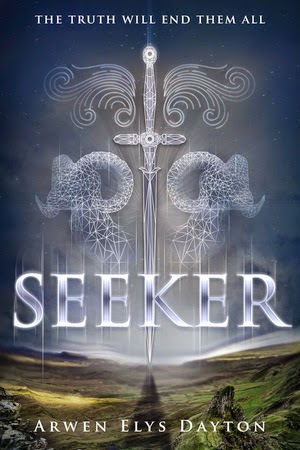
Review: Seeker by Arwen Elys Dayton

https://www.goodreads.com/book/show/20911450-seeker
Seeker by Arwen Elys Dayton
Original Publication Year: 2015 (February 10)
Genre(s): Fantasy, YA
Series: Seeker #1
Awards: None
Format: eBook - Thanks to Delacorte Books for Yong Readers for providing me with an advanced reader copy of this book (via NetGalley).  My review reflects my honest opinion of and experience with the book and was not influenced by receiving the book for free from the publisher. 
Narrated by: NA


The story begins on an ancient Scottish estate in a unspecified future or perhaps even an alternate now.  Teenagers John, Quin and Shinobu are all hoping to pass their final test by combat and be initiated into the secretive and very rare ranks of the Seekers.  John is denied the privilege and it is clear there is some dark history between he and the master Seeker Briac who is also Quin's father.  Quin and Shinobu are initiated but find, to their horror, that being a Seeker is not what they imagined it to be.  As they are dealing with this, John returns to claim one of the sacred tools of the Seekers which he believes is his by birthright and he continues to incompetently pursue this instrument for the rest of the book causing all sorts of trouble for his once girlfriend Quin.
I will be very interested to see other people's responses to this YA Sci-fi/fantasy.  I had a lot of problems with it but don't know how many of them relate more to 1) not being a teenager or 2) not being in the mood for the particular tone of this book.  I'd rate it a three out of five star read because it does have some marks in the good column but the strikes in the negative column were weightier.

What I liked:
- I generally like multiple perspective books and this had 4 Point-Of-View characters divided into chapters.  I thought it worked relatively well to fully present the story. 
- The world that is presented is very interesting.  It creates this interesting mash-up of Sci-Fi and Epic Fantasy, feeling both ancient and futuristic often at the same time.  The Seekers and their tools also reflect this blend of ancient and modern and I particularly liked the idea of the whip sword which I envisioned as a light saber but with the ability to produce many type of blades and weapons from the handle. 
- The story frequently surprised me and went in directions I wasn't expecting which is always good!
- I like what Dayton was trying to do, exploring the idea of "absolute power, corrupts absolutely".  She embodies this somewhat in one of the characters who is a villain without realizing he is a villain, which I found really interesting and would have like explored more in depth. 
- The character of Maud and everything about the Dreads (supposedly neutral observers and arbiters of the Seekers who can play with time) was very intriguing.  In fact, I wish the book had been about them. 
- The ending scene is super exciting and is almost worth getting through all that comes before. 

What I Didn't Like:

- The tone is extremely emo and angsty, almost from page one.  One of the characters tries to commit suicide for goodness' sake.   It's like being thrust directly into Mockingjay without the buildup of two books to explain or give weight to the intense negative emotions all of the characters are experiencing.  This is where mood and personal preference may have come into play.  This tone is not my cup of tea and I was particularly not in the mood here.  I did not like Mockingjay, The Order of the Phoenix is my least favorite Harry Potter - i.e. I'm not a big fan of reading about teenagers wallowing in self pity even when they have a good reason to be doing so. 
-  The plot relies too heavily on secrets and in many cases it's hard to even understand why they are secrets.  John wants something and he was charged to get it by his dead mother and feels like he is not only justified but also entitled to the thing but he will not explain this to the girl he supposedly loves - he instead threatens and browbeats her.  For her part, she has a complete lack of curiosity as to why the boy she loves is all of the sudden threatening and browbeating her and instead blindly resists his requests because she doesn't want John to experience the horrible things she has.  BUT... you guessed it... she doesn't tell him about the horrible things but instead tells him vaguely and rather patronizingly that he shouldn't have it.  If these two characters had interacted like actual human beings who cared for one another there would have been no plot - or it would have been very different and I may have liked it better.
- As I alluded to above, I found 3 out of the 4 POV characters, at best boring, at worst downright irritating.  Quin has no personality, and is completely self-delusional but that doesn't stop her from being holier than thou whenever she gets the opportunity. Shinobu is a selfish jerk for 3/4 of the book. John at first seemed intriguing but quickly became very annoying, not because he was doing questionable things, but because he was so ridiculously stupid and incompetent at it all. 
- The Romance:  We are thrust right into the middle of a love triangle which isn't one of my favorite things to begin with.  We have no relationship development and there is exactly zero chemistry between any of the characters.

Well looky there!  I was able to pull out more things I liked than things I disliked!  Unfortunately, the things I disliked had a little more affect on my reading than the good stuff. 

FINAL VERDICT: I think this book will work for some readers especially if you like your YA fantasy dark and angsty.  While I found some things to like I don't think I will continue on in the series. 3 out of 5 Stars.

Sunday, February 1, 2015

REVIEW: The Eterna Files by Leanna Renee Hieber


Original Publication Year: 2015 (February 3)
Genre(s): Fantasy
Series: Yes but not named yet.
Awards: None
Format: eBook - Thanks to Tor Books for providing me with an advanced reader copy of this book (via NetGalley).  My review reflects my honest opinion of and experience with the book and was not influenced by receiving the book for free from the publisher. 
Narrated by: NA

The Eterna Files tells the story of two secret government agencies, one in America and one in England, during the Victorian period.  They are both investigating the supernatural phenomena surrounding an attempt to achieve immortality through a mix of science and magic.  This pursuit of immortality was begun when Clara Templeton as a girl of 11 or 12, trying to comfort the recently bereaved Mary Todd Lincoln, suggests that great people such as Abraham Lincoln should never be subjected to death.  The quest for immortality begins there and has been under way for more than a decade on both sides of the pond, when things start to go horribly wrong and all of the scientists involved are mysteriously killed.

Unfortunately, The Eterna Files has a promising premise but this first book, in what promises to be a series, did not deliver on that promise.  It never really gelled for me and there was very little forward movement.  Overall, I felt like I was dropped into the middle of a complex Gothic setting and storyline and never really caught up or was able to be immersed in the story. 

Part of the problem was the scope and huge cast of characters.  Characters were still being introduced 30% into the book and I had a hard time connecting with any of them or even distinguishing who were the most important to the story.  Certainly Clara on the American side and then Spire and Rose Everhart in England.  However, each “agency” on either side also has a number of other crew members and a benefactor plus several ancillary characters and I was never really sure how important any of these folks was meant to be and in some cases how they fit in.   Even with the three main characters, I never really got an intimate sense of who they were despite the fact that they carry a good portion of the perspective voice.  The interactions and actions of the characters never felt entirely natural to me either and sometimes I was actively confused about a characters reaction to occurrences.  Rose was the one character I found intriguing. She decided on a career over the normal existence of a Victorian lady and has used a tragedy in her life to leverage a support position in the highest levels of the British government. 

As may be apparent the story is split into two narratives, one taking place in America and one in England with alternating chapters.  There is a hint of tenuous connection between the two storylines but it doesn’t come to fruition in this book and it often seemed like I was reading two separate books exacerbated by the lengthiness of the chapters.  This split also threw the pacing off and resulted in it taking longer than necessary to achieve any sort of forward momentum.  I started to get somewhat engaged in the stories around 40% in and stayed mildly engaged until the end when the book just petered out in the middle of a scene.  For this two pronged storyline to work I think it needed to be snappier with its pacing.

The book is relatively dark and Gothic and Hieber does a really good job describing the setting and producing a tangible atmosphere.  However, I was hoping for a sense of humor and a page turning supernatural mystery. It is described on Net Galley as a cross between the X Files and the Dresden Files, perhaps because they both have the word files in their name because I saw little other similarity.  That comparison gave me an inappropriate expectation about the tone of the book which is darker and much more humorless than either of those franchises.  I noticed that this comparison does not appear in the Goodreads description which is a good thing.  The book most reminded me, in tone, in the choppiness of the narrative, in the lack of intimacy with the characters, of The Somnambulist by Jonathan Barnes for which I also did not care.  

FINAL VERDICT:  An ambitious book with a promising premise but in the end it wasn’t for me.  2 out of 5 Stars. 

Monday, September 8, 2014

REVIEW: City of Stairs by Robert Jackson Bennett

City of StairsCity of Stairs by Robert Jackson Bennett
My rating: 5 of 5 stars


Original Publication Year: 2014 (September 9th)
Genre: Fantasy
Series:?, I hope it’s the first in a series!
Awards: None
Format: e-Advanced Reader Copy through Netgalley.  Provided to me for free in exchange for a fair review.
Narrated by: NA


For some reason, I had it in my head that this was going to be a serious and melancholy book. Maybe it's the cover? Or the blurb? I don’t know where the impression came from but I was pleasantly surprised by what I got. It is not a book without weight but it is decidedly more fun than melancholy.

Shara is an intelligence agent from Saypur, the current ruling power on her world, and she is called to the former ruling city of Bulikov, now occupied by Saypur, to investigate the death of a Saypuri historian. This historian is an authority on the Gods that used to play large roles on the continent, with Bulikov at its heart, and who had allowed the continent to oppress Saypuri for many years. The Saypuris had rebelled and developed a weapon that killed the Gods…or did they? I am doing a horrible job at explaining the plot but essentially it’s a mystery with a goodly dose of political intrigue. It's involved and complex but not confusing - just hard to explain adequately. The setting is fantastical but not completely unrecognizable and Bennett has created a rich and fascinating mythology and history for his world. There was lots of plot to get immersed in!

The biggest complaint I’ve seen in many places is that the book is too slowly paced. This leaves me agog as I thought nothing of the sort. However, I also really enjoy Jane Austen and novels about the everyday mundanities of people, particularly in a past or otherwise unfamiliar setting. So perhaps this is fantasy for Austenites? Regardless, I thought the pace was perfect and at no point was bored though I guess if you’re looking for non-stop action and adventure you may be disappointed. Lots happens it's just not all jumping, shooting and shouting.

One thing that really kept me reading were the fantastic characters. Shara is a great heroine and narrator. In fact, while it is very different narratively this book's general tone reminded me of The Rook(by Daniel O’Malley), mostly because Shara from this book and Myfanwy of The Rook were similar character types – career driven, ordinary in appearance, extremely clever and quite snarky and the reader is almost entirely in their head. Shara is backed up by some really great supporting characters, as well, especially her violent factotum Sigrud and the colonial governor of Bulikov, Mulaghesh. Bennett takes the time to give all the characters, even those of the secondary variety, some back story and depth. I LOVED this.

It’s fair to say that I’m a fan and really enjoyed the book. I’d describe it as a drily humorous multi-faceted mystery set in a richly drawn fictional universe and told with characters that I loved learning about and spending time with. It also contradicted my expectations at times, particularly with an ex-boyfriend that appears and in its portrayal of the two featured countries - both Bulikov and Saypur seem equally corrupt and damaged, i.e. the oppressors are not universally bad nor the oppressed all good. Plus I always enjoy a mythology where the Gods physically interact with their followers. In the end, it ticked all the boxes that I wish to be ticked!

Final Verdict: I loved it and I really hope this is not the last book that will be set in this universe!