Monday, June 3, 2013

Across The Universe by Beth Revis

Across the Universe (Across the Universe, #1)Across the Universe by Beth Revis
My rating: 3 of 5 stars

Format: Audio
Running Time: 10 hours
Narrated by: Lauren Ambrose and Carlos Santos
Original Publication Year: 2011
Genre(s): Science Fiction, Young Adult, Mystery/Suspense
Series: Across the Universe, Book 1

A generation ship, the Godspeed, travels from Earth with a terra forming mission on a new planet 300 years away. People with essential skills have been recruited to travel as frozen cargo, to be awakened upon touchdown on Centauri-Earth. Among those chosen are 17 year old Amy’s two parents. So although she is considered non-essential she is also frozen and provided a berth on the ship. But these frozen folks aren’t the only residents of Godspeed. The ship is also home to almost 3000 souls who operate the ship and live and have children and die onboard.

When Amy is violently awakened from her cryosleep 50 years before the ship is meant to land she finds a confusing and alien situation on the ship. The only people that act normally are in the mental ward of the ship's hospital and everyone is under the tyrannical rule of the ship's leader called Eldest. His successor Elder is about Amy’s age and is one of the first people she encounters upon waking. They become allies in a rebellion they don’t entirely realize they’re waging.

The framework for the book is alternating chapters between Amy and Elder’s perspectives which I think is pretty effective and gives you two different perspectives of what’s happening on the ship. The plot is centered on a number of mysteries and ethical questions raised by the unique situation. Very little on the ship is what it seems. As happened to Amy, someone is waking the cryo-sleepers too early seemingly with the intent of killing them (two die and a few others are rescued). Who is doing this and why? Why does everyone on Godspeed act almost mindless and without independence? Who is Elder exactly and why is Eldest so reluctant to teach him what he must know to succeed him? Who is the mysterious Orion who pops up from time to time? Is there ever a time when tyranny is okay? Is it ever okay to lie? Can people really live generations in a closed ship in space without going mad?

I am of two minds about this book which is a state I frequently find myself in when reading Young Adult fiction. I think the unhappy part of my reaction usually has to do with the protagonists who are usually teenagers. Because the primary audience for young adult books is teenagers the teenage protagonists are often validated in their actions and thoughts. Now I’ve been a teenager and I look back at being that age and I realize how completely ignorant and clueless I was about life and the world. For most teenagers, I think the world is a much more black and white place and the complexity of gray that comes with more experience and age is unrecognized. So when a teenage character is screeching about the black or the white of a situation when it is very clearly gray and yet the character is validated to a degree that their screechiness leads to some leadership position which no teenager ever should ever be given…well it irritates a bit. I do realize the most fool proof solution to my irritation is to stop reading YA but apparently I prefer reading it and then being persnickety. Sorry.

So the biggest offender amongst the protagonists of this book is Amy. From the moment she awakes she does nothing but screech at people about everything. She is indignant about everything, immediately and without reflection. Yes the stuff going down on the ship is extremely sketchy but she is holier than thou practically from moment one and is convinced (and validated) after only like 4 days on the ship that everything must change though we see her giving no thought ever to the complications or implications of her brave new world on the ship. And she calls her father Daddy. I know that is a convention in some families but for me it made her seem younger and more infantile than she was and I trusted her “leadership” less and less.

Elder is more bearable. While he has some very teenage qualities he is also more thoughtful and introspective about the situation on the ship. He more fully sees that the system put into place since the plague isn’t right but he also understands why it was done. The sorts of moral dilemmas he contemplates are much more interesting though I can see that the book needed the screeching Amy character to trigger and move things along. But might it not have been more interesting to see Elder come to the point of revolution on his own with perhaps some help from his friends on the mental ward? I’m not sure but he was definitely the more interesting character then his counterpart Amy.

There were lots of elements that I thought were done really well. There was a lot to unravel and even though I guessed a number of things early it was still interesting to see how they played out. The true nature of Orion, even though I knew who he was almost from moment one, was a surprise. Eldest was an interesting character that in the end was painted as power hungry and corrupt, however some of the behavior we see from him indicate that he is a grayer character - that there is some struggle and torment. I think there is great potential for the future books.

A couple of nitpicks: 1) the shippers, or the scientists and engineers on the ship were not even touched on, I suspect because it would have been hard to fit them into the author's vision of the ship of mindless drones – it’s hard to suck out independent thought from people whose job it is to think and 2) it was a little unbelievable that Eldest would take zero to less than zero interest in protection of the cryo-sleepers once the murders begin. He takes no steps to safeguard them, leaving it conveniently to Elder, Amy and Harley to do an almost 100% ineffective job at guarding the cryo- area.

Finally, the narrators were okay. Lauren Ambrose had a little bit more flair with the reading but Amy was written sort of odd and whiny so it was hard to make her terribly convincing. I think Carlos Santos was a little deadpan in his reading but it wasn’t overly bothersome and I got used to him quickly. Both of them sounded convincingly like teenagers.

So do any other more mature adults like reading young adult lit but then get completely exasperated with the characters or is that just my special idiocy? 

View all my reviews

Saturday, June 1, 2013

The Sanctuary Sparrow by Ellis Peters

The Sanctuary Sparrow (Chronicles of Brother Cadfael #7)The Sanctuary Sparrow by Ellis Peters
My rating: 3 of 5 stars

Format: Audio
Narrated by: Vanessa Benjamin
Original Publication Date: 1983
Genre(s): Historical (Middle Ages), Mystery
Series: The Cadfael Chronicles, Book 7

This book starts with a jolt - a murderous mob chasing a skinny, wretched young man into sanctuary at the Monastery church. This young man, whose name is Lilliwen, is a traveling musician, juggler and acrobat and the mob believes he has murdered (though the man is not,in fact, dead) and stolen from a local wealthy goldsmith. Despite the fact that the goldsmith lives, all is not right in his home and soon his neighbor and his elderly but strong-willed mother are dead. Cadfael believes Lilliwen, the sanctuary sparrow, to be innocent and investigates with Hugh Beringar to find the real culprit.

Another great installment though it felt slightly different from the others in the series. It has a more domestic focus and Cadfael seems more absent than usual. We also get to spend some time with another brother of the monastery, Brother Anselm.

This seventh book in the series was especially interesting to me for the look it gives into the domestic arrangements of a “middle class” home in the Middle Ages. The household has been run competently for many years by the goldsmith’s spinster daughter Susannah but the son and heir of the house, Daniel, has just married.  Daniel’s new wife, Marjorie, is rather interesting. She is described as being homely but of pleasant demeanor and coming with a good dowry. We soon find that she is also a strong woman who sets about taming her wayward husband without him even knowing its happening and sets up a confrontation with Susannah for control of the household. I liked Marjorie, though she is not always portrayed in the kindest light. It was interesting to see,through her, Susannah and the old matriarch of the house, how women did exert some levels of power and control despite their seemingly low status in society.

I also very much admired how Susannah was portrayed. I was definitely sympathetic to her situation while also feeling how her treatment had warped her character to a degree that she could no longer feel much of anything for others. The scene of confrontation between her and Marjorie is particularly well done as you see the justice of Marjorie’s claims but also feel the injustice of Susannah being so discarded. It becomes more intriguing when we know that Susannah at this point should not care that she must give up her role and so her reasons for arguing are cloudy… is it bitterness, playacting or a little of both?

I definitely enjoyed this one. This is the second book read by Vanessa Benjamin and in my mind she has improved as a narrator though I am still not crazy about the voice she gives Cadfael.

What do you think of this series of mysteries?  How do you think this one fits in the series? What did you think of Marjorie and her manipulative ways - like her or hate her?

View all my reviews

Thursday, May 30, 2013

What Matters in Jane Austen? by John Mullan

What Matters in Jane Austen?: Twenty Crucial Puzzles SolvedWhat Matters in Jane Austen?: Twenty Crucial Puzzles Solved by John Mullan
My rating: 4 of 5 stars

Format: Hardback
Original Publication Date: 2012
Genre(s): Nonfiction, Literary
Series: No

This enjoyable book by John Mullan is a collection of analytical essays, combing through Jane Austen’s books to answer various targeted questions. Each essay is roughly 15-20 pages long which took me, a relatively slow reader, about 20 minutes to read. The questions he asks of Austen’s books are aimed at revealing levels of detail and pattern that would likely have passed by the average reader. For example some of my favorite essays were:

Chapter 3: What do the Characters Call Each Other?
Chapter 9: Which Important Characters Never Speak in the Novels?
Chapter 13: How Much Money is Enough?
Chapter 19: When does Jane Austen Speak Directly to the Reader?
Chapter 20: How Experimental a Novelist was Jane Austen?

Mullan takes each question and points out the occurrences and significance in each of the novels. In some cases this means pointing out some things that would have been obvious to her contemporary readers like the discussion of money but are lost on the modern reader. Sometimes he is pointing out patterns and speculating about what Austen was inferring. He also sprinkles in some snippets from Austen’s life and letters to illustrate how her actual experiences support the interpretations presented. I’ll admit that there were a few instances I felt he might be attributing meaning to the meaningless but overwhelmingly this was a book that enriched my own appreciation of her books and made me want to re-read all of them.

I particularly enjoyed the final essay on Austen being an experimental writer. I feel like she is often dismissed as the chick lit of her day and that there is nothing challenging about her work. The usual defense against this is to point to her wit which was extraordinary and her insightful observation and portrayal of Regency era society. Mullan points out that she also used some techniques that were not common in novels of the day. For example her heroines are rarely perfect (with possibly the exception of Fanny Price), but are still likeable despite myriad flaws and misjudgments. She also, particularly in Emma, somewhat pioneered the idea of portraying as reality the worldview of her protagonist – we the reader believe the world to be ordered as the protagonist sees it even when she is quite wrong in her view. He points out that in Persuasion, the reader is not just in Anne’s head we are almost in her body at times, experiencing only what she physically experiences. He indicates that at the time this approach was unusual and distinctly Austen’s own style.

My biggest complaint is that I think I would have enjoyed this book most if I had been able to dip into it on a leisurely basis whenever I was craving a little jolt of Austen. Unfortunately, I got it from the library where there were many other holds so I had to rush through rather than savor.

Overall it was a pleasure.

So have you ever noticed some details in Austen's novels that you thought particularly brilliant? Do you ever dream of finding a man who has $10,000 a year?

View all my reviews

Monday, May 27, 2013

The Virgin in the Ice by Ellis Peters

The Virgin in the Ice (Chronicles of Brother Cadfael #6)The Virgin in the Ice by Ellis Peters
My rating: 4 of 5 stars

Format: Audio
Narrated by: Vanessa Benjamin
Original Publication Date: 1982
Genre(s): Historical (Middle Ages), Mystery
Series: The Cadfael Chronicles, Book 6

The Civil War that has been threatening between King Stephen and Empress Maude starts in earnest, sending refugees fleeing in all directions. A trio of refugees; a young, noble sister and brother and a nun; have disappeared into the snowy English countryside of 1139.

As with all the books I’ve read in this series there are many threads to follow. I almost felt bad for Cadfael and Hugh having to track down all those threads in the bitter cold and snow. There are: a missing brother and sister (the Hugonins), a battered and amnesiac monk with a secret he doesn’t even know he carries, a defiled and murdered nun encased in ice, a mysterious knight roaming the countryside, strangely secretive and serving as guardian angel to the Hugonins and a band of brigands taking advantage of the chaos of war to pillage and plunder. As soon as one of Hungonins is found the other disappears. Somehow amidst all this Hugh and Cadfael stay calm and all the various threads are neatly tied by the end with plausible and interesting solutions. Cadfael even has something personally important that he didn’t expect or look for revealed to him.

The more I read of this series, the more impressed I become of Peters dexterous weaving of multiple story threads and her creation of a new cast of thousands for each book. Cadfael and a few other regulars keep us in familiar territory while the new characters make each book fresh. I know that many mystery series operate like this but I think she does a particularly good job of creating new characters that are distinct and believable. In this book in particular there were many mysteries to solve and revelations to be had so there is never a dull moment.

I very much enjoyed this one and it compares well with The Leper of St. Giles which was also exceptionally well done.

The narrator for this book changed from the two previous and to my mind not for the better. I got used to Vanessa Benjamin but really don’t like the voice she gives to Cadfael – I much preferred Johanna Ward’s attempt at a Welsh lilt for him. Many of Vanessa Benjamin’s men sound very much alike. Also the audio quality was not as good but that may have been related to my downloading it from the library.


View all my reviews

Saturday, May 25, 2013

Doctor Who - Season 6 - Episodes 7-13

http://www.scifinow.co.uk/wp-content/uploads/2011/03/BB238826@DOCTOR-WHO.jpg 

A Good Man Goes To War (Episode 7)


Rory and The Doctor set off on their mission to find and rescue Amy.  They start by recruiting a lot of old friends who owe the Doctor favors.  They are successful in rescuing Amy and she and Rory's newborn daughter Melody Pond.  Or so they think...The beginning of this one is a right hot mess and the pacing of the whole episode is bizarre.  The idea of the Doctor building an Army and waging war is a little out of character even if the take over is basically more theatrical than violent.  I was really having a hard time making connections between the lady with the eye patch, the headless monks, the marines and the Silence.  Isn't the Silence supposed to be behind all this malarkey?  But we see nor hear hide nor hair of them.  I was spoiled on the revelation at the end of the episode but I can imagine it was probably a stunner when it happened.  Grade: C

Let's Kill Hitler (Episode 8)

This is basically the beginning of River Song's story. A lot happens in this episode. Rory, Amy and the Doctor are reunited after a couple months apart and in roars Amy and Rory's best friend Mels of whom we've never seen or heard.  She hijacks the TARDIS and they travel back to 1938 and accidentally save Hitler from being punished by a time traveling justice seeking robot run by a lot of miniaturized humans.  Mels is shot and dying but reveals that she can regenerate and turns into River Song.  And we're still in the first 15 minutes...
There is almost too much going on in this episode but most of it I liked.  The robot run by lots of miniaturized human and policed by mechanical antibodies is cool even though its origin is never really explored or explained - it's just a plot device.  So time lords can change their age at will - did we know that?  Though I'm not a big River Song fan this is an interesting beginning to her story though I still kinda hate the whatever it is between she and the Doctor.  One little thing I liked was seeing the former companions even if they were just holograms:)  Grade: B

Night Terrors (Episode 9)

The Doctor gets the following message on his psychic paper: "Please save me from the monsters." He traces it to a down at the heels estate, where a little boy is terrified of the lift and the monsters living in his cupboard.  While the Doctor talks with the boy, the elevator sends Rory and Amy to a strange world they can't make heads or tales of.  In the end they all find themselves being tormented by creepy dolls in a ..."Refuge for dirty posh people who eat wooden food or..termites..giant termites that want to get on The Property Ladder" aka a dolls house.

This is a lovely creepy episode that plays on the terrors of little kids.  There's also a nice dash of pedophobia. And it's interesting that they have this one off episode about an unexpected, not normal kid wreaking havoc - nice connection to the larger storyline whether deliberate or not.   It's visually very interesting.  All in all this whole season has been very nice visually.  I am starting to get rather irritated with Matt Smith's super fast mumbly speak - I feel like I'm missing a good quarter of what he says. Grade: B+

The Girl Who Waited (Episode 10)

"What's the answer that won't get us killed?"  Always a wise questions to ask when you're traveling with the Doctor.  Amy is separated from Rory and the Doctor on a planet with two time streams, one fast, one slow. One week for Amy, is just moments for Rory and the Doctor.  The Doctor sends Rory out to track her down and when he does find her, 36 years have passed for her.

This is another one that is visually stunning.  Karen Gillan does an awesome job playing an older Amy who hasn't had any human contact for 36 years.  In general she does a great job in this episode.  This is also the Doctor's Dilemma in 43 minutes - It's a microcosm of what he always faces with his companions. He will always be forced to let them down and make the ugly choice.  I LOVE when Doctor Who is poignant and creative. There were tears during this one. The last line is Killer with a capital K. And as a non sequiter, I think I'm falling a little in love with Rory. Grade: A

The God Complex (Episode 11)

aka Hotel California - You can check out anytime you like but you can never leave.  Our fearless Trio find themselves in a cheesy and demonic 1980's hotel.  There are a few other folks there as well - 3 humans and an alien from a planet with the distinction of being the most invaded.  Each person has a room for them that has their own personal worst nightmare. And the TARDIS has disappeared!  Even more freaky... "It's amazing that you've just come up with a theory that's even more insane then what's actually happening.."  suddenly Rory's getting all the great lines.

This is one of those episodes that swings between absurdly comical and holy buckets of creepy.  I suspect there's also some scathing commentary on organized religion hidden in there. There's a nice hidden message that faith in the Doctor will get you consumed.  It is again the Doctor's dilemma - how he is always the undoing of his companions. It's a nice development of the Doctor.  And again the episode's design is awesome - they've really outdone themselves this series. In the end the Doctor tries to do the right thing though somehow I doubt it will stand. And leaving with another lovely Rory quote.  "We've forgotten that not all victories are about saving the universe." Grade: B+

Closing Time (Episode 12)

The Doctor shows up to say hello to Craig (from the series 5 episode The Lodger) and he and Sophie's baby Stormaggedon Dark Lord of All aka Alfie.  During this somewhat awkward visit The Doctor notices some electrical fluctuations and his savior complex kicks in.  So he get's a job at a department store, in the toys section of course. And apparently Amy's become a model in the meantime. Hmm...

Craig is from one of the episodes that I actually liked in Series 5 so I was excited to see him again.  As with the original episode this is mostly played for laughs and it works well.  The scene where the Doctor tries to distract Craig by declaring his love is pretty hilarious.  The Doctor is also feeling a little nostalgic about his life as he believes it's coming to an end.  It has a sappy, sentimental but lovely Doctor Who type ending.  And I wish I could have The Doctor's cleaning service. And we're back where we started with series 6...interesting. This season has been really nicely constructed though I don't really want to think to hard about the timeline...I'll just settle for timey wimey stuff happens. Grade: B+

The Wedding of River Song (Episode 13)

We open in an alternate universe where Winston Churchill is the Holy Roman Empire, pterodacyls and hot air balloon carried cars float in the sky and all history has been smooshed into one moment; 5:02 pm on April the 22nd.  Then we are following the Doctor as he travels trying to discover why the Silence believe he has to die. The Doctor's attitude can be summed up thus: to the Doctor: "Time catches up with us all Doctor."  The Doctor: "But it's never laid a glove on me." And we're back at Lake Silencio in Utah. And we find out why River has been in jail since we've met her. 

Despite feeling a little queasy whenever I thought too hard about how things happened, I did very much enjoy it.  I thought it was head and shoulders above the Series 5 finale and sets up some interesting story lines for Series 7.  It's a little all over the place but it does pull all the threads together by the end in a way that more or less makes sense.  Overall a nice wrap up to a really excellent season. Grade: B

Series 6 Review

Well color me very pleasantly surprised and very happy to be surprised too.  After my lackluster response to Series 5 I thought I was done with Doctor Who which was definitely pretty sad in a first world problem sort of way.  But it turns out Series 5 just kind of sucked! Who knew!  Glad to see the show runner's are hitting their stride and now I am super anxious to see Series 7.  Which will be a very long time from now. Sigh... I do wish they worked on a faster time frame.

 The biggest positive surprise was that I finally warmed up to Amy and Rory.  I actively disliked Amy and she's still not my favorite companion, but her obvious moments of devotion to Rory and some particularly nice acting by Karen Gillan (particularly in The Girl Who Waited) stole a tiny little sliver of my heart.  I had been indifferent to Rory but, especially in the second half of the series, he really developed some personality outside of lovesick puppy dog following Amy.  I really liked him by the end of the series.

And then there's River Song.  In this series, her character had more of a point and was really integral to the through line so I got to a point where I was pretty tolerant of her.  And while I didn't really get the point of "the marriage" it didn't fill me with rage either because it was such a brief and secondary event. I definitely feel like her character arc has come full circle though and I do hope we are pretty much done with her.   

My favorite episodes from this season in chronological order: The Curse of the Black Spot (episode 3), The Doctor's Wife (Episode 4) and The Girl Who Waited (Episode 10). It's worth noting that there wasn't a single episode I didn't like.  All in all an impressive season!

Some unanswered questions I'm left with: How does River Song travel through time without a TARDIS?  Can Time Lords travel through time without a TARDIS? Oh yea and that question about changing their age at will?  Am I the last person to know they can do these things? And most importantly what did you think of Series 6?  What was your favorite episode(s)?  Are there any one-off characters you wish the Doctor would go back and visit?  When writing out The Doctor is the "the" capitalized or not?

Friday, May 24, 2013

The Leper of St. Giles by Ellis Peters

The Leper of Saint Giles (Chronicles of Brother Cadfael #5)The Leper of Saint Giles by Ellis Peters
My rating: 4 of 5 stars

The Abbey at Shrewsbury is to host the middle ages equivalent of the celebrity wedding of the year, between a consequential but much older lord and a highly manipulated young woman of great property. While the two to be wed care little for each other, the groom and the bride's guardians (her Aunt and Uncle) see the material advantages. The bride's affections and happiness are engaged elsewhere with a young squire in her groom-to-be's household. When the groom doesn't show up for his wedding and is found dead in the woods things start to become tricky. Meanwhile at the local leper colony, there is a particularly mysterious newcomer who takes a great interest in the hullabaloo at the Abbey.

This is a lovely convoluted mystery with links to the crusades and which involves a mysterious and awesome mistresses and some wicked guardians. It's a great and detailed plot with plenty of nuance even if the solution at the end is somewhat reminiscent of a Scooby Doo or Poirot mystery where all is unraveled and revealed in a big flourish.

Again we have a large new cast to get acquainted with and Peters makes it easy to distinguish and get to know them. Joscelin Lucy is a particularly engaging young hero who is believably young and somewhat self-consciously chivalrous. We see the entrance of the hapless Brother Oswin who plagues Cadfael as his assistant and Peters descriptions of his enthusiasm and clumsiness are hilarious. The denizens of the Leper colony that we meet are equally charming especially the little boy Bran and the mysterious Lazarus.

It's interesting to see how Lepers were treated in Medieval times when the causes of the disease were not understood and the effects were devastating and often deadly. Considering the amount of fear and disgust associated with lepers it is amazing that colonies for their care existed and emphasizes the bravery of the uninfected souls that chose to care for them. Peters uses this to her advantage - Joscelin's acceptance and willingness to move amongst these folks are a testament to his strength of character.

The narration by Johanna Ward is again excellent.

View all my reviews

Thursday, May 23, 2013

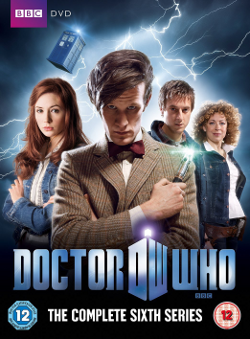
Doctor Who - Season 6 - Episodes 1-6


 File:Doctor Who Series 6.png

 Because Doctor Who is amongst my favoritest TV shows of all time, I've been incredibly sad to have trouble connecting with the reboot starting with Matt Smith as Doctor #11.  A re-watch of season 5 helped me develop an appreciation for Matt Smith but it did not improve my feelings for Amy Pond or River Song.

So, the point of all that rambling is to say I've been slow to watch Season 6.  But buzz about the upcoming 50th Anniversary episode this November (and the knowledge that Amy is no longer the companion in Series 7), has given me a little shove in the Season 6 direction. I'll write about each episode in turn and then try to summarize my overall feelings about the season halfway through and then the second half and feelings on the whole shebang in a second post. Here goes:


The Impossible Astronaut and Day of the Moon (Eps 1 and 2)

The Majority of the action in these two episodes takes place in the U.S. during 1969. Amy, Rory, River Song, and a random ex-FBI Agent receive Tardis Blue invitations with a date, time and coordinates. When they get there they run into the Doctor who announces they will be heading to 1969 but he doesn't say why. This is definitely one of the more convoluted and mysterious plots which works best the less you know so I'll leave it at that vague point.

I liked all the twists and turns in this one and it sets up the big bad for the near future of the series really well. The Silence are seriously creepy. It also introduces and leaves untied a lot of loose ends which will be slowly developed and revealed throughout the season. I was also quite impressed that the plot was subtly started in Season 5 - nice long-term plotting! My favorite moment was probably the Doctor stumbling unintentionally and clandestinely into the Oval Office ("I was looking for the oblong room!") - It is played really well by Matt Smith. Because I'm not a River Song fan, I really didn't like all the flirty flirty and angst with the Doctor. But overall this was a great two part season opener - An improvement over Season 5's two parters.
Grade: B+

Curse of the Black Spot (Episode 3)

Pirates! Doctor Who and PIRATES! You had me at Pirates.  "Yo ho ho. Erm..Or does no one actually say that?" The Tardis is drawn by a distress signal to a 17th century pirate ship in the middle of a becalmed sea that is being terrorized by a Siren.  As soon as anybody on the ship is injured in any way they are marked with a black spot and the Siren appears and zaps them away with her touch.

I really liked this episode!  It's a fun one-off. The solution to who/what the siren is, was clever.  And did I mention there are pirates?  Things I liked - Pirates!  And all the Doctor's fun with the pirate cliches.  The one scene I didn't care for was CPR on Rory - it was manipulative and overdone and unoriginal and ugh.  However, so far I'm really enjoying Season 6... Grade: A

The Doctor's Wife (Episode 4)

 The episode starts off with The Doctor getting mail!  It's a distress signal from another Time Lord called The Corsair.  In response, The Doctor, Amy, and Rory rush off to a pocket of the universe that's been isolated from the regular universe and they encounter some very strange folk.  In the end this is a love story between the TARDIS and her Doctor...Awww....

It's like the delicious child produced in a union between Terry Gilliam and Tim Burton.  Love, love, love the soul of the TARDIS personified. The actress who plays her was lovely. We get to see more of the Tardis' innards and its surprisingly boring. I love that the TARDIS thinks Rory is the pretty one.  I love the Doctor's "excitement" about his TARDIS being a Lady (whose name is Sexy). And finally I love the TARDIS kicking some ass!  If you can't tell I very much like this one!  And I've just figured out why  - it was written by Neil Gaiman! Grade: A+

 The Rebel Flesh and The Almost People (Episode 5 and 6)

This an episode ala the small-crew-trapped-in-an-out-of-the-way-place-and-bad-things-start-going-down which they have in every series (The Time of Angels and Flesh and Stone in series 5, Silence in the Library and Forest of the Dead in series 4, 42 in series 3, The Impossible Planet and The Satan Pit in series 2, Bad Wolf and Parting of The Ways in Season 1).  This time the out of the way place is a medieval monastery on an island of future Earth where a small group of people are using sentient Doppelgangers of themselves to mine an extremely caustic acid.  When a solar storm hits there are suddenly two of everyone and conflict is inevitable.

Doctor Who frequently likes to question what makes a sentient being  - what is a person with worth of their own (New Earth from series 2 is one example that comes quickly to mind). These two episodes do an okay but not great job of addressing the question because basically the humans and the doppelgangers are equally corrupt.  I liked that Rory got to be a little independent and wasn't trailing after Amy like a lovesick puppy the whole time even if he was pretty ineffectual. Nice twist at the end and the final scene is properly scary! Grade: B

Well at this point my relief is HUGE.  I thought I was done with Doctor Who but no such tragedy.  Thus far Series 6 has been fantastic even with Amy Pond and River Song. Can't wait to see what the second half of Series 6 has to offer.

What was your favorite episode in this first half of series 6 and why? Did you have the same lack of enthusiasm for series 5 as I did?